
Flag of India
Three colours and a wheel express the values of independent India.
- Adopted and changed
- 22 July 1947
Design
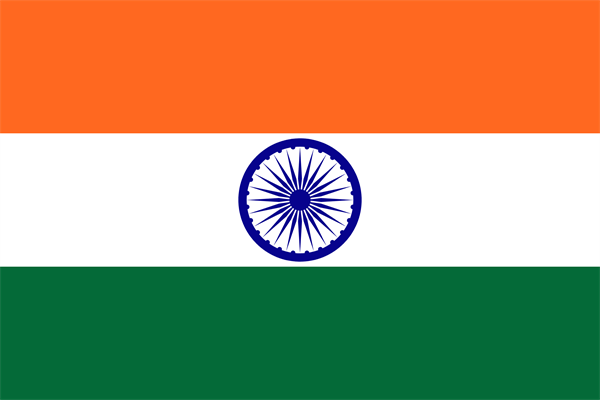
Saffron, white and green horizontal stripes; in the centre, a navy-blue Ashoka Chakra with 24 spokes.
What it means
In India's official description, saffron stands for strength and courage, white for peace and truth, and green for the fertility of the land and growth. The wheel is linked to dharma, the principle of right conduct; it also carries the idea of movement and progress.
The story
The flag was adopted by the Constituent Assembly a few weeks before independence. The design is a continuation of the tricolour flags used in the independence movement. The spinning wheel that had earlier been in the centre was replaced by the Ashoka Chakra, inspired by the wheel seen on the Lion Capital of Ashoka at Sarnath. In this way an ancient historical symbol became the shared emblem of the new state.
Sources: knowindia.india.gov.in, Flags of the World (specialist archive)
Flag of Pakistan
The green field and the white stripe bring different faith communities together on one flag.
- Adopted and changed
- 1947
Design
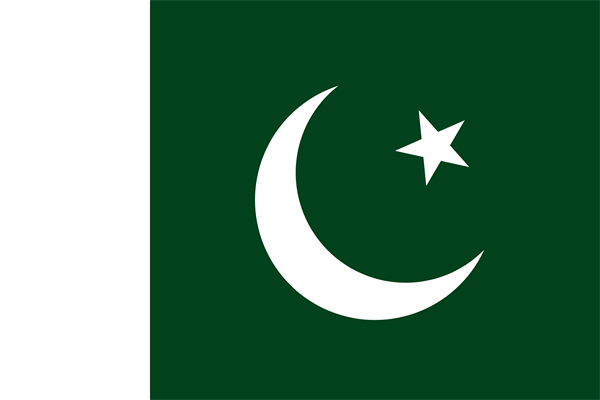
A dark green field with a white vertical stripe at the hoist; on the green field, a white crescent and star.
What it means
In official explanations, green represents the Muslim majority and the white stripe represents the religious minorities; the crescent represents progress, and the star represents light and knowledge.
The story
The design adopted at the founding of Pakistan continued the Muslim League's tradition of a green flag with a crescent and star. The white stripe became a distinctive element showing that the new country was not made up only of the majority. In this way the emblem of a political movement was turned into a national flag meant to represent all the communities of the state.
Flag of Bangladesh
A red sun rising on a green field carries the memory of independence.
- Adopted and changed
- 1972; its predecessor in the independence struggle dates from 1971
Design
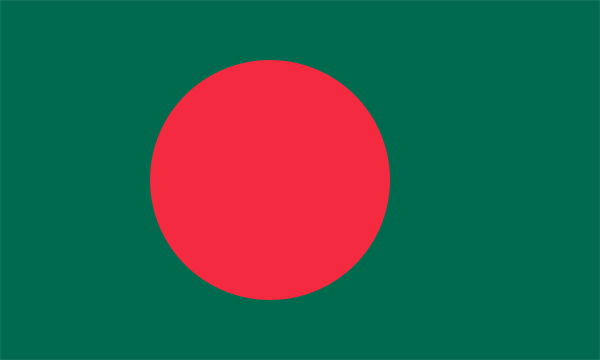
A dark green field with a red disc placed slightly towards the hoist, the edge of the flag attached to the pole.
What it means
According to the common explanation, green stands for the country's vibrant nature, and the red disc for the rising sun and for those who lost their lives in the 1971 independence struggle. The constitution describes the design; it does not spell out all of these meanings one by one.
The story
The flag used in 1971 had a yellow map of the country inside the red disc. After independence the map was removed, and the plain design of today emerged. The difficulty of reproducing the map neatly on both sides of the cloth is one of the frequently cited reasons for the change. The present flag therefore recalls the first design of the struggle and is also easy to recognise from a distance.
Sources: bdlaws.minlaw.gov.bd, legislation.nysenate.gov
Flag of Nepal
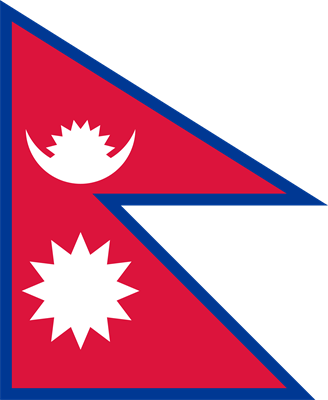
The two-pennant flag of Nepal is the only national flag in the world that is not a rectangle.
- Adopted and changed
- The current simplified form dates from 16 December 1962.
Design
Two joined crimson triangles with a blue border, with a moon symbol on the upper one and a sun symbol on the lower one.
What it means
The moon and sun are explained as a wish that Nepal will last as long as they do. Crimson is the traditional national colour; in the common interpretation the blue border represents peace. Linking the triangles to the Himalayas is a popular interpretation.
The story
The flag continues the long South Asian tradition of triangular pennants. When the modern standard was set in 1962, the human faces on the moon and sun were removed. The distinctive shape was kept when the country became a republic. In this way a flag inherited from the monarchy remained the shared national sign under the new government.
Flag of Bhutan
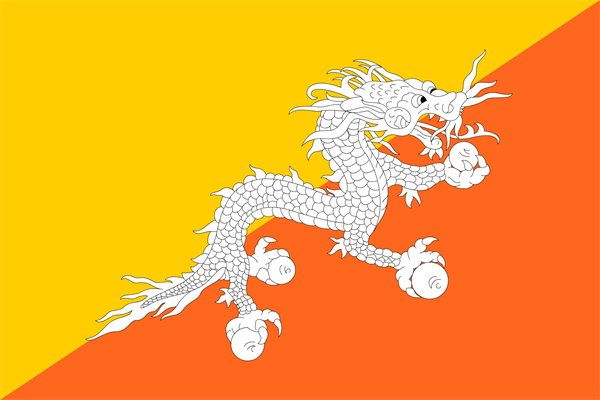
Bhutan's white dragon carries the country's Thunder Dragon tradition.
- Adopted and changed
- Current form 1969; earlier designs go back to the 1940s
Design
A field divided diagonally into yellow and orange; in the centre, a white dragon holding jewels in its claws.
What it means
Yellow represents the worldly authority of the monarchy, orange the Buddhist spiritual tradition, and the white dragon purity. The jewels symbolise prosperity and the country's wealth.
The story
The dragon is linked to Bhutan's local name, Druk Yul, and to the Drukpa Buddhist tradition. The first modern flag was closer to a square, and over time its proportions, colours and the dragon's posture changed. The current design became established in 1969.
Flag of Sri Lanka
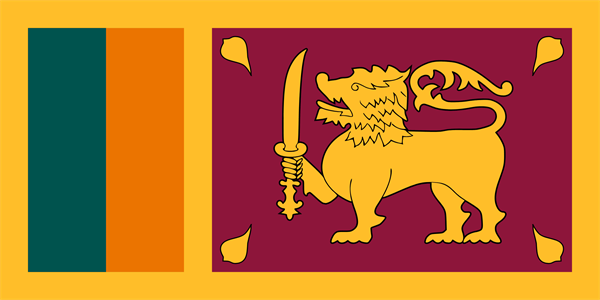
The lion, leaves and coloured stripes bring together Sri Lanka's different traditions.
- Adopted and changed
- The layout with green and orange stripes dates from 1951; the more prominent bo leaves from 1972.
Design
A golden lion holding a sword and four bo leaves on a maroon field, with green and orange stripes at the hoist and a golden border.
What it means
The lion represents the Sinhalese tradition and the sword represents sovereignty; orange represents the Tamil and green the Muslim communities. The four bo leaves are associated with Buddhist virtues. The golden frame is explained as the space that unites the different communities.
The story
The lion section of the flag is based on the banner tradition of the Kingdom of Kandy. A committee set up after independence added stripes representing the minority communities to the new national flag. This design was adopted in 1951. When the republic was founded in 1972, the bo leaves in the corners were arranged more prominently.
Flag of the Maldives
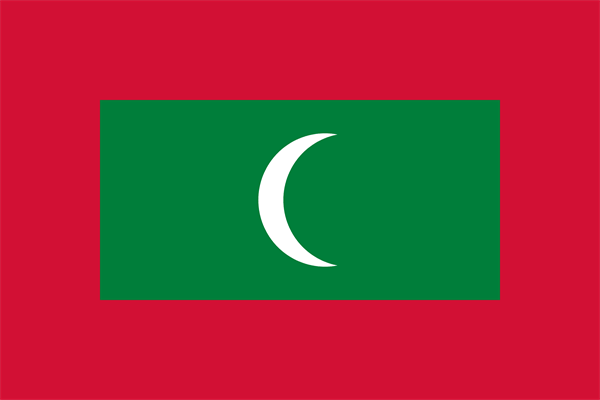
The Maldives' crescent sits on a green field within a red frame.
- Adopted and changed
- Current basic form, independence period of 1965
Design
A green rectangle inside a red field; a white crescent in the centre.
What it means
Red represents the sacrifices made for the country's independence, green represents peace and prosperity, and the white crescent represents the Islamic faith.
The story
Old Maldivian flags were plain red. In time a black and white pattern was added on the hoist edge, followed by the green field and the crescent. When the edge pattern was removed in the independence period, today's plain appearance emerged.
Flag of Afghanistan
Depends on the context
When describing Afghanistan's flag, the period and context being used must always be stated.
- Adopted and changed
- White flag of the de facto administration: since August 2021
Design
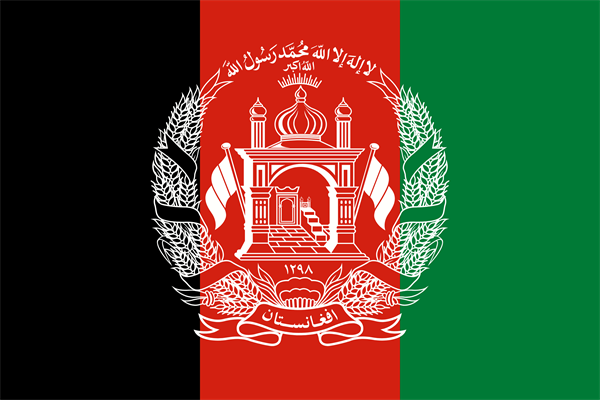
De facto administration: black shahada on a white field. Former republic: black-red-green vertical stripes and a white emblem.
What it means
The text on the white flag is the Islamic declaration of faith. The colours of the republic's flag are commonly linked with past hardships, the struggle for independence and hope; the explanations have varied through history.
The story
Afghanistan has used many flags as governments changed. After the Taliban took control again in 2021, the white flag became the symbol of the de facto administration inside the country. The tricolour flag of the former republic continues to be used in some diplomatic, sporting and diaspora contexts.
Versions and context
- Flag of the de facto administration — after 2021: A white field with a black shahada. Used in the context of the de facto administration inside the country.
- Flag of the former republic: Black-red-green vertical stripes and a white emblem. It continues in some diplomatic, sporting and diaspora contexts.
Sources: Flags of the World (specialist archive), afghanembassy.ca, media.unesco.org
Flag of Kazakhstan
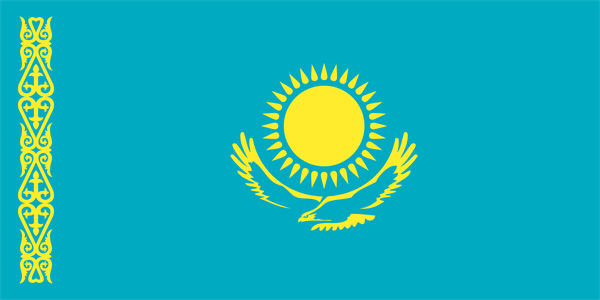
On Kazakhstan's flag, a steppe eagle soars beneath the sun.
- Adopted and changed
- 4 June 1992
Design
A sky-blue field; a golden sun, an eagle and a traditional ornament at the hoist.
What it means
Blue stands for the sky, peace and unity; the sun for life and abundance; and the eagle for freedom and high aims. The vertical ornament represents Kazakh culture.
The story
The design by Shaken Niyazbekov was adopted after the dissolution of the Soviet Union. Sky, steppe and traditional art were brought together to build an identity linked to nature for the new state.
Flag of Uzbekistan
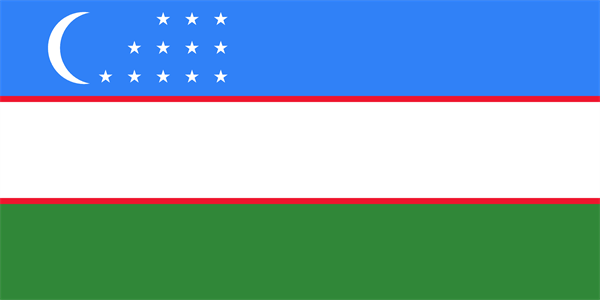
Uzbekistan's flag links a new state with older cultural traditions.
- Adopted and changed
- 18 November 1991.
Design
Horizontal stripes of blue, white and green, with thin red dividing lines, a white crescent and 12 stars.
What it means
In the official description, blue stands for the sky and water, white for peace and good wishes, green for nature and renewal, and the red lines for the strength of life. The crescent evokes the newly independent state; the 12 stars evoke the historical calendar and cultural traditions.
The story
The flag, prepared during the process of leaving the Soviet Union, was adopted in 1991. The design brought together in one layout the historical colours of the region, celestial signs and the beginning of the new state. Besides its religious associations, the crescent is also explained in the official account through the birth of the young independent republic.
Flag of Kyrgyzstan
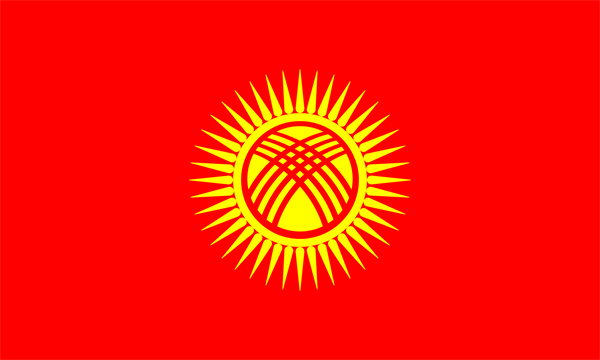
Kyrgyzstan's sun brings together the story of the forty tribes and the roof of the yurt.
- Adopted and changed
- 3 March 1992; current drawing change in December 2023
Design
A red field; a yellow sun with 40 straight rays and, at its centre, a red tunduk drawing.
What it means
The forty rays are linked with the union of the forty tribes in the Manas tradition. The tunduk is the opening at the top of the traditional yurt; it represents home, unity and shared life. Red is explained by courage and the Manas tradition.
The story
After independence the flag was adopted in 1992. The rays of the first sun were wavy. With the change made in December 2023, the rays were straightened and the inner drawing of the tunduk was renewed. The colours and the basic symbols were kept while the geometric appearance changed.
Versions and context
- Kyrgyzstan — after December 2023: Straight 40 sun rays and two groups of four bars in the tunduk.
Sources: Flags of the World (specialist archive), Wikipedia (history and versions)